
Clinical picture. M., a woman in her late twenties, presents with three to four hours of daily preoccupation with the appearance of her jaw and skin texture; she has reduced her social engagements significantly over the preceding year. In the initial assessment session, the clinician introduces the seven-stage Veale model using the informational sheet, walking through each stage and inviting M. to trace a recent episode, a glance at her reflection in a lift door, onto the diagram. M. identifies the narrowing of attention and the felt inner image as the stages she finds most recognisable, noting that the image in her mind feels far worse than any photograph. By the end of the session she can articulate, in her own words, that the checking and concealment behaviours maintain the loop rather than resolve it. No symptom change is claimed at this point; the shared model simply provides a common language for the work ahead.
CBT Model of BDD (Veale, 2004): PDF Worksheet, Tools and Exercises
A visual PDF worksheet clinicians can use in session to explain Veale's seven-stage BDD maintenance loop, clarify the role of safety behaviours, and build a shared psychoeducation framework with patients.
Clinical vignettes
Mapping the Loop in a First Session
Psychoeducation Disrupting Reassurance Seeking
Clinical picture. T., a man in his early forties, was referred following repeated dermatology consultations for a perceived scalp irregularity that clinicians had consistently found unremarkable. During the second CBT session, the therapist uses the informational sheet to highlight the relief-that-feeds-the-loop section, connecting it directly to T.'s pattern of seeking reassurance from his partner each morning before leaving the house. T. initially frames these reassurance requests as rational checks; reviewing the sheet together, he begins to see how each confirmed answer trains the appraisal that a real defect exists and requires monitoring. He agrees, cautiously, to trial a single morning without asking, logging the urge intensity at intervals. The outcome is modest but clinically useful: T. reports that the urge peaked and then subsided without the reassurance, which opens a productive discussion about safety behaviours and their role in sustaining self-as-object processing.
BDD is notoriously resistant to verbal psychoeducation alone. Patients arrive with years of failed reassurance-seeking, cosmetic consultations, and mirror rituals, and they struggle to see the loop they are caught in. This fiche PDF gives you a concrete visual structure to make Veale's (2004) maintenance model legible in session, fast.
Use this resource with your patients
Handout, exercises and materials ready to use, right inside SessionFuel.
Why the BDD Maintenance Loop Is So Hard to Explain at the Whiteboard
The core clinical difficulty is that BDD patients do not experience their distress as a cognitive loop. They experience it as a defect. Explaining that "it's not really about your face" without a map typically produces polite nodding, then disengagement. The self-as-object processing at the centre of Veale's model is phenomenologically alien: patients have often never named the distinction between their actual face and the felt inner image they are reacting to.
A second difficulty is differential diagnosis. Patients and referring colleagues frequently conflate BDD with social anxiety, with OCD, or with body image concerns in eating disorders. Without a shared vocabulary and a visible schema, these distinctions evaporate mid-conversation.
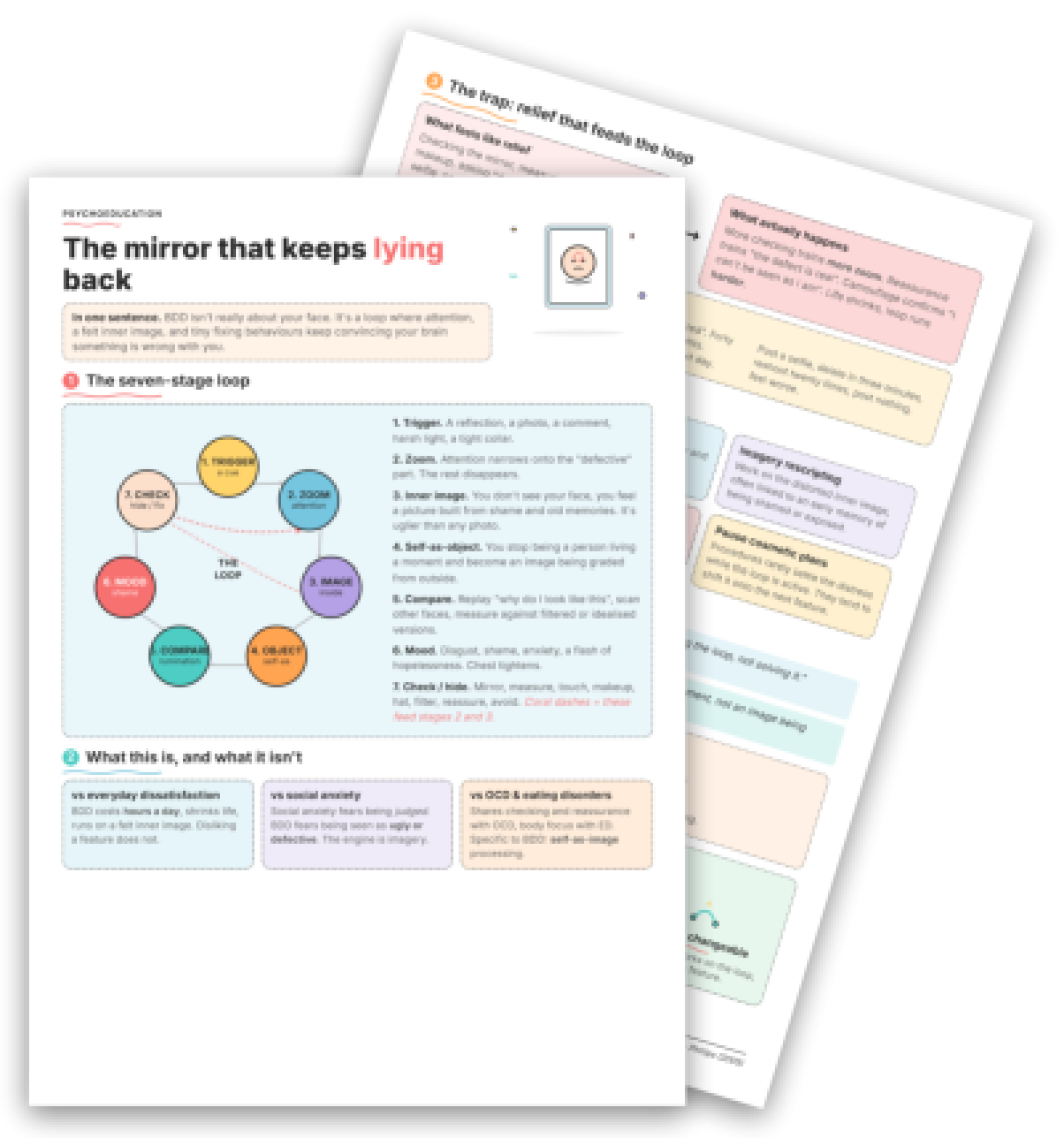
What the Fiche Contains: A Visual Map of the Seven-Stage Loop
The fiche is built around a seven-stage loop diagram, clearly labelled and sequentially numbered so you can walk through it with the patient without looking away from the page. The stages are: Trigger, Zoom, Inner Image, Self-as-Object, Compare, Mood, Check/Hide. Coral dashes on the diagram show exactly which exit routes (mirror-checking, reassurance, camouflage) re-enter the loop at stages 2 and 3, reinforcing attentional narrowing and the distorted inner image. This visual is what an oral explanation cannot replicate: the patient sees, literally, that checking maintains the loop rather than resolving it.
Section 2 of the fiche provides a three-column differential table, distinguishing BDD from everyday appearance dissatisfaction, from social anxiety, and from OCD. The engine named for BDD is imagery-based self-as-object processing, which positions it cleanly alongside but distinct from reassurance-seeking in OCD.
Section 3 makes the relief paradox explicit: "More checking trains more zoom. Reassurance trains 'the defect is real'." This framing, already in the patient's hands as a printed sentence, is clinically more durable than a therapist's explanation alone. Section 4 lists the six intervention levers in Veale's protocol: broadening attention, mirror retraining, imagery rescripting, behavioural experiments, dropping safety behaviours, and pausing cosmetic plans. The fiche closes with "phrases to keep in your pocket" and a short list of session-discussion prompts, including checking rituals consuming more than thirty minutes daily and active cosmetic procedure planning.
> Key point: This fiche is a visual support that facilitates the explanation of the BDD loop in session. It is not a self-monitoring form the patient completes alone. You use it to show the mechanism, establish a shared vocabulary, and leave the patient with a concrete reference between appointments.
600+ clinical tools
A library built with and for clinicians, ready to use in session and extend between appointments.
Access all the toolsWhen and How to Propose It
The fiche fits best at the psychoeducation phase, once the initial anamnesis is complete and a working alliance is established, typically sessions 2 to 4. For patients who have already been through cosmetic consultations or who are currently planning a procedure, you can introduce it earlier as a frame for that conversation, referencing the fiche's note that "procedures rarely settle the distress while the loop is active."
A neutral introduction: "I want to show you a map that researchers have built of how this kind of distress tends to sustain itself. It might help us locate exactly where in the cycle you spend most of your time." This avoids labelling the patient as "dysmorphic" before the alliance can hold that.
Walk through the seven stages using their own recent examples, noting where their personal safety behaviours re-enter the loop. Then hand the fiche over and direct attention to the session-discussion prompts. At the following appointment, the debriefing question is simple: which stage felt most recognisable?
The fiche pairs naturally with a graded exposure hierarchy once the loop is mapped, and with imagery rescripting work when the inner image connects to early shame memories. For patients whose BDD presentation includes marked perfectionism or low self-esteem, situating this model alongside a broader self-image programme deepens the psychoeducation arc. Clinicians embedding this within a full CBT cognitive model framework will find the loop diagram slots directly into case formulation work.
One contraindication to flag: for patients with active suicidal ideation linked to BDD severity (common at the severe end of the Phillips spectrum), the loop diagram should be preceded by a stabilisation phase. Presenting the maintenance model to a patient in acute crisis without adequate containment can temporarily amplify shame before it reduces it.
The fiche does not replace clinical formulation or the therapeutic frame. It makes one notoriously difficult concept visible at exactly the moment in session when visibility matters most.
Use it with your patients
Share this tool in the mobile app and follow the work between sessions.
Sources
- Veale, D. (2001). Cognitive-behavioural therapy for body dysmorphic disorder. Advances in Psychiatric Treatment, 7, 125-132.
- Veale, D., & Neziroglu, F. (2010). Body Dysmorphic Disorder: A Treatment Manual. Wiley-Blackwell.
- Wilhelm, S., Phillips, K. A., & Steketee, G. (2013). Cognitive-Behavioral Therapy for Body Dysmorphic Disorder: A Treatment Manual. Guilford Press.
Your session continues in your patients' pocket
Use with a patientYour resources, available everywhere
The handouts, exercises, programs and audios above: you choose which ones to make available to your patients, in the mobile app dedicated to them.
And far more than a library
The app goes well beyond resources, to support your patients every day:
Related categories
Explore other clinical resources by category.

Anxiety
Clinical hub for anxiety disorders: CBT and ACT worksheets, psychoeducation sheets, and exercises for assessment and treatment across the anxiety spectrum.

Understand
Clinical hub for the therapeutic aim 'Understand': worksheets and tools to build patient insight across CBT, ACT, schema therapy and more.

Build awareness
Clinical worksheets and tools to build awareness in therapy: cognitive distortions, schemas, emotions, ACT and CBT resources for practitioners.

CBT
CBT worksheets, cognitive restructuring exercises & behavioral tools for clinicians. Evidence-based resources for every phase of cognitive behavioral therapy.

Trauma
Clinical hub on trauma and PTSD: assessment, differential diagnosis, treatment phases, and printable resources for practitioners. 155 chars.

Mood
Evidence-based worksheets and clinical tools for mood disorders: CBT, ACT, and positive psychology resources for psychologists and therapists.