
Clinical picture. A., 34, presents with generalised anxiety and avoidance of professional visibility; she is scheduled to lead a team briefing and rates her certainty that she will "freeze completely and lose all credibility" at roughly 90%. The clinician introduces the thought-widener worksheet and asks her to map three outcomes for the same situation: worst, most likely, and best. A. initially writes "everyone loses confidence in me" in the likely column, and the clinician uses the ten-people prompt to help her separate genuine probability from anxiety-amplified expectation. By the following session she reports having delivered the briefing, described her actual experience as matching her revised likely-outcome column, and noted that the catastrophic prediction had not materialised.
Challenging Anxious Thoughts: PDF Worksheet, Tools and Exercises
A structured PDF worksheet with visual tools and exercises to help clinicians explain cognitive restructuring of anxious thoughts clearly and efficiently in session.
Clinical vignettes
Probability Overestimation Before a Work Presentation
Time-Zoom on a Social Slip
Clinical picture. M., 28, describes persistent rumination after mispronouncing a word during a group discussion three weeks prior; he rates the event as "permanently damaging" to how colleagues perceive him. The clinician uses the time-zoom component of the worksheet, walking M. through the one-week, one-month, and one-year checkpoints for the feared consequence. M. acknowledged, somewhat reluctantly, that colleagues had shown no change in behaviour toward him and that he had rarely thought about a comparable slip from the previous year. This reframe did not eliminate his social discomfort, but it reduced his rated likelihood that the event would still feel significant in twelve months from 80% to around 25%, which he found meaningful enough to continue practising the technique independently.
In session, patients with anxiety can nod along as you explain probability overestimation and catastrophising, then walk out the door with nothing that sticks. This PDF worksheet gives you a visual structure to anchor the explanation in real time, so patients leave with a concrete reference, not just a fading memory of what you said.
Use this resource with your patients
Handout, exercises and materials ready to use, right inside SessionFuel.
Why correcting anxious thinking with words alone tends to fall short
The two distortions named in the fiche, overestimating probability ("I just KNOW this will go wrong") and magnifying consequences ("I'll never live this down"), are automatic, fast, and ego-syntonic. Explaining them verbally runs into a familiar paradox: the patient's in-session affect is lower than it will be at 11pm at home, so the distortions feel abstract when you describe them. They can repeat the mechanism back to you without the shift actually happening.
The second sticking point is the "likely outcome" column. Patients completing a standard thought record frequently write a second worst-case there rather than a genuinely probable one. Without a visual prompt, this error is invisible until the homework comes back marked up. For patients prone to all-or-nothing thinking or fortune-telling, the gap between what they call "likely" and what is statistically probable is exactly where the therapeutic leverage sits. The fiche catches this in the room, before the patient leaves.
What the fiche contains: a structured visual for the explanation
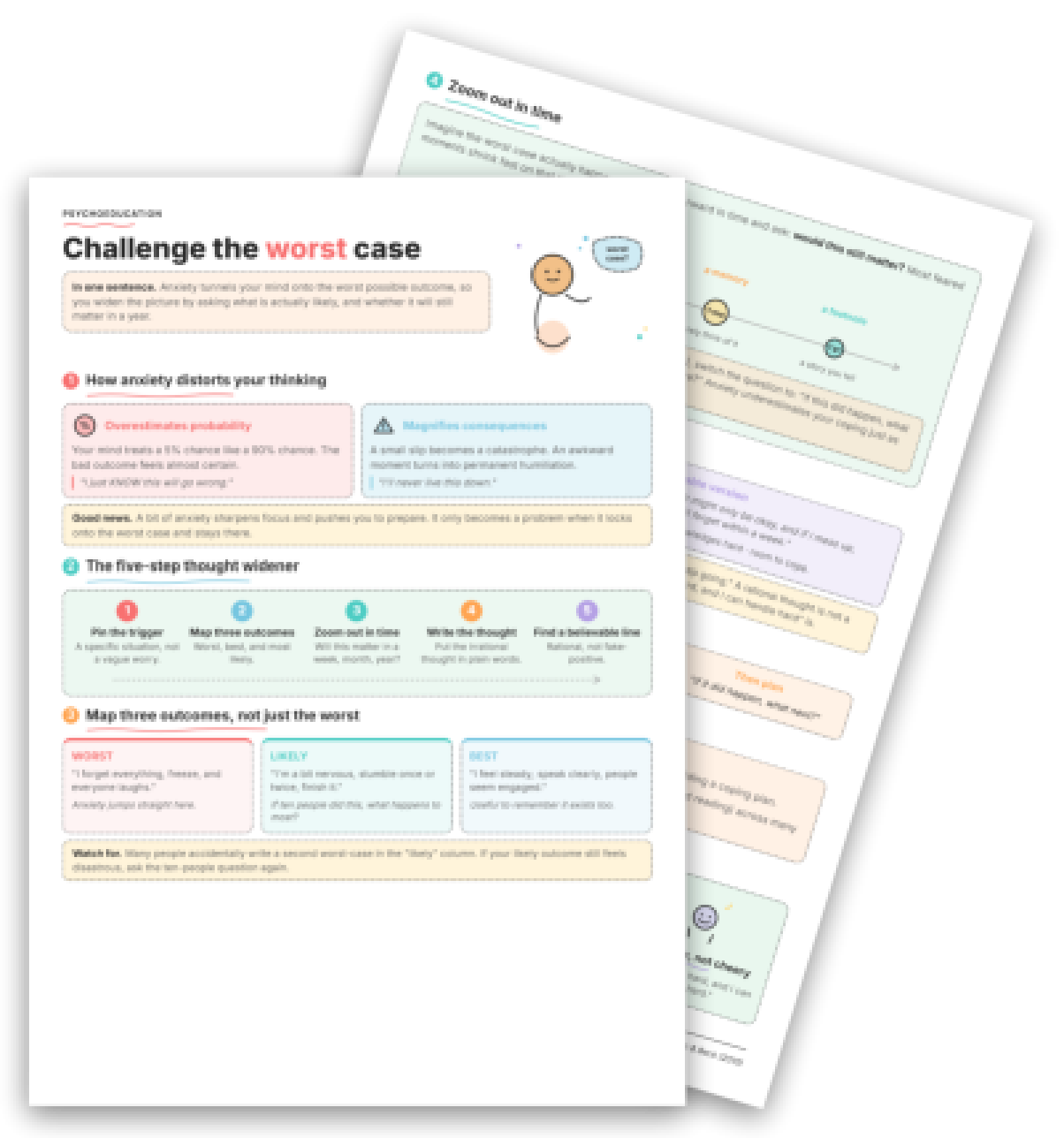
The fiche is built across eight numbered panels, designed to be read together with the clinician, not completed in isolation. Its spine is a five-step "thought widener": pin the specific trigger, map three outcomes (worst, best, most likely), zoom out in time, write the irrational thought in plain words, then find a believable alternative rather than a falsely positive one. The distinction matters, and the fiche states it plainly: "This might be hard, and I can handle hard" is the target, not an empty reassurance.
Panel 3 lays the three outcomes spatially so the patient can see at a glance where anxiety collapses all probability mass onto the worst case. The visual contrast across columns does more explanatory work than a verbal description: it shows, rather than tells, why catastrophising is a selective attentional process. A useful built-in prompt asks: "If ten people did this, what happens to most?", which shifts the frame from subjective certainty to population-level probability.
Panel 4 offers a temporal zoom-out grid, tracking the same feared event across now, one week, one month, and one year. The layout makes shrinkage legible. For patients who would still rate the worst-case as catastrophic at one year (a real loss, a genuine diagnosis), the fiche pivots explicitly to coping planning: "What have I survived before? Who would I call?" rather than continuing to challenge probability. That pivot is built in so you don't have to improvise it mid-session.
A final brief panel gives three portable self-questions for moments when the patient cannot sit with paper, bridging the in-session work to daily life and supporting generalisation between appointments.
> Key point: The fiche is a visual support that facilitates the in-session explanation of cognitive restructuring; it is not a questionnaire the patient fills in alone, but a shared reference that leaves them with a concrete tool to return to between sessions.
600+ clinical tools
A library built with and for clinicians, ready to use in session and extend between appointments.
Access all the toolsWhen and how to introduce it in session
The fiche fits naturally into the psychoeducation phase of CBT, once the cognitive model has been introduced and the patient can connect thoughts to emotional responses. For patients already working on identifying automatic thoughts, it adds the temporal dimension and the three-outcome structure. It pairs well with the ABC model for practitioners working within an REBT frame, and it can follow naturally from a catastrophising-focused thought record.
Clinically, it is most useful with presentations involving generalised anxiety, social anxiety, and anticipatory fear, including patients already working through an anticipatory decatastrophising exercise as homework. Patients with health anxiety or OCD require careful framing: the probability-correction logic applies, but coping planning should be foregrounded rather than reassurance-seeking, and you will want to note this explicitly before handing the fiche over.
To introduce it, you might say: "I'd like to walk through a structure that maps what your mind does when anxiety spikes. Not to tell you the worry is wrong, but to widen the picture." After going through the five steps together, leave the fiche with the patient and ask them to apply it to one specific trigger before the next session, using the three-question panel as a portable prompt when writing is not possible.
Debrief by asking which of the three outcomes they found hardest to generate. The likely outcome is almost always where the work is.
Use it with your patients
Share this tool in the mobile app and follow the work between sessions.
Sources
- Beck, A. T. (1976). Cognitive Therapy and the Emotional Disorders. Meridian / New American Library.
- Burns, D. D. (1980). Feeling Good: The New Mood Therapy. William Morrow.
- Clark, D. A., Beck, A. T. (2010). Cognitive Therapy of Anxiety Disorders: Science and Practice. Guilford Press.
Your session continues in your patients' pocket
Use with a patientYour resources, available everywhere
The handouts, exercises, programs and audios above: you choose which ones to make available to your patients, in the mobile app dedicated to them.
And far more than a library
The app goes well beyond resources, to support your patients every day:
Related categories
Explore other clinical resources by category.

Anxiety
Clinical hub for anxiety disorders: CBT and ACT worksheets, psychoeducation sheets, and exercises for assessment and treatment across the anxiety spectrum.

Cognition
Printable cognitive therapy worksheets and clinical tools for therapists: CBT, ACT, schema work, defusion, distortions, and belief restructuring.

Understand
Clinical hub for the therapeutic aim 'Understand': worksheets and tools to build patient insight across CBT, ACT, schema therapy and more.

Build awareness
Clinical worksheets and tools to build awareness in therapy: cognitive distortions, schemas, emotions, ACT and CBT resources for practitioners.

Restructure
Clinical hub for cognitive restructuring worksheets: distortion identification, belief disputation, ABC model, and schema work for evidence-based practice.

CBT
CBT worksheets, cognitive restructuring exercises & behavioral tools for clinicians. Evidence-based resources for every phase of cognitive behavioral therapy.