
Clinical picture. T., a woman in her late thirties, presented with OCD centered on door and appliance checking; she reported checking the front lock between eight and twelve times each morning before leaving for work, arriving late and distressed regardless. During a psychoeducation session, the clinician introduced the checking-certainty loop, explaining that each additional check overwrites the memory of the previous one, leaving a vague sense of having checked "at some point" rather than a sharp, retrievable recollection. T. recognized this immediately, noting that by the fifth check she felt less certain than after the first. She agreed to track the number of checks alongside her self-rated confidence over three days, and her own data confirmed that confidence scores dropped as check frequency rose, providing a concrete entry point for response prevention work.
Checking, Certainty, and Doubt: PDF Worksheet, Tools and Exercises
A visual PDF worksheet for clinicians to explain the checking-doubt loop in session, with a structured 2-day behavioural experiment and ready-to-use psychoeducation tools.
Clinical vignettes
Repeated Checking Eroding Felt Confidence
Mental Replaying as Covert Checking
Clinical picture. M., a man in his mid-forties, sought treatment for persistent doubt about whether he had behaved offensively toward colleagues, spending several hours each evening mentally replaying conversations from the workday. The clinician used the informational sheet on checking and certainty to draw a parallel between physical checking of a lock and covert mental replaying, explaining that silent replays carry the same memory-blurring effect as overt behavioral checks. M. had not previously framed rumination as a form of checking and was initially skeptical. After a brief self-monitoring exercise, he noticed that each replay left the target conversation feeling less clear rather than more resolved, which he found genuinely informative rather than reassuring. This reframe shifted the treatment focus toward postponing replays rather than seeking a definitive internal verdict.
Most patients with compulsive checking understand, at some level, that the behavior is excessive. What they rarely grasp is the precise mechanism making it counterproductive: each additional check degrades the very confidence it was meant to restore. Explaining this loop verbally, without a visual scaffold, rarely produces the shift that changes behavior. This PDF worksheet gives you a concrete, session-ready support to make the paradox legible.
Use this resource with your patients
Handout, exercises and materials ready to use, right inside SessionFuel.
Why the Checking-Doubt Loop Resists Verbal Explanation
The core mechanism, documented by Radomsky & Rachman (1999) and elaborated by van den Hout & Kindt (2003), is counterintuitive: repeated checking impairs memory confidence without impairing memory accuracy. The patient's factual knowledge stays intact; what erodes is their felt certainty about that knowledge. When you explain this at the whiteboard, most patients nod, then revert. The concept doesn't stick because it runs against the intuition that "checking = verifying = certainty."
The reassurance-seeking dynamic compounds this. Patients often extend the loop socially, seeking confirmation from a partner or family member. Salkovskis (1999) frames this as cognitive avoidance, maintaining the original doubt rather than resolving it. A dedicated reassurance-seeking exercise can address this parallel track, but first the patient needs a clear map of why seeking reassurance feeds the same memory-distrust mechanism as physical re-checking. The fiche is that map.
600+ clinical tools
A library built with and for clinicians, ready to use in session and extend between appointments.
Access all the toolsWhat the Fiche Contains: A Visual Tool for the Checking Loop
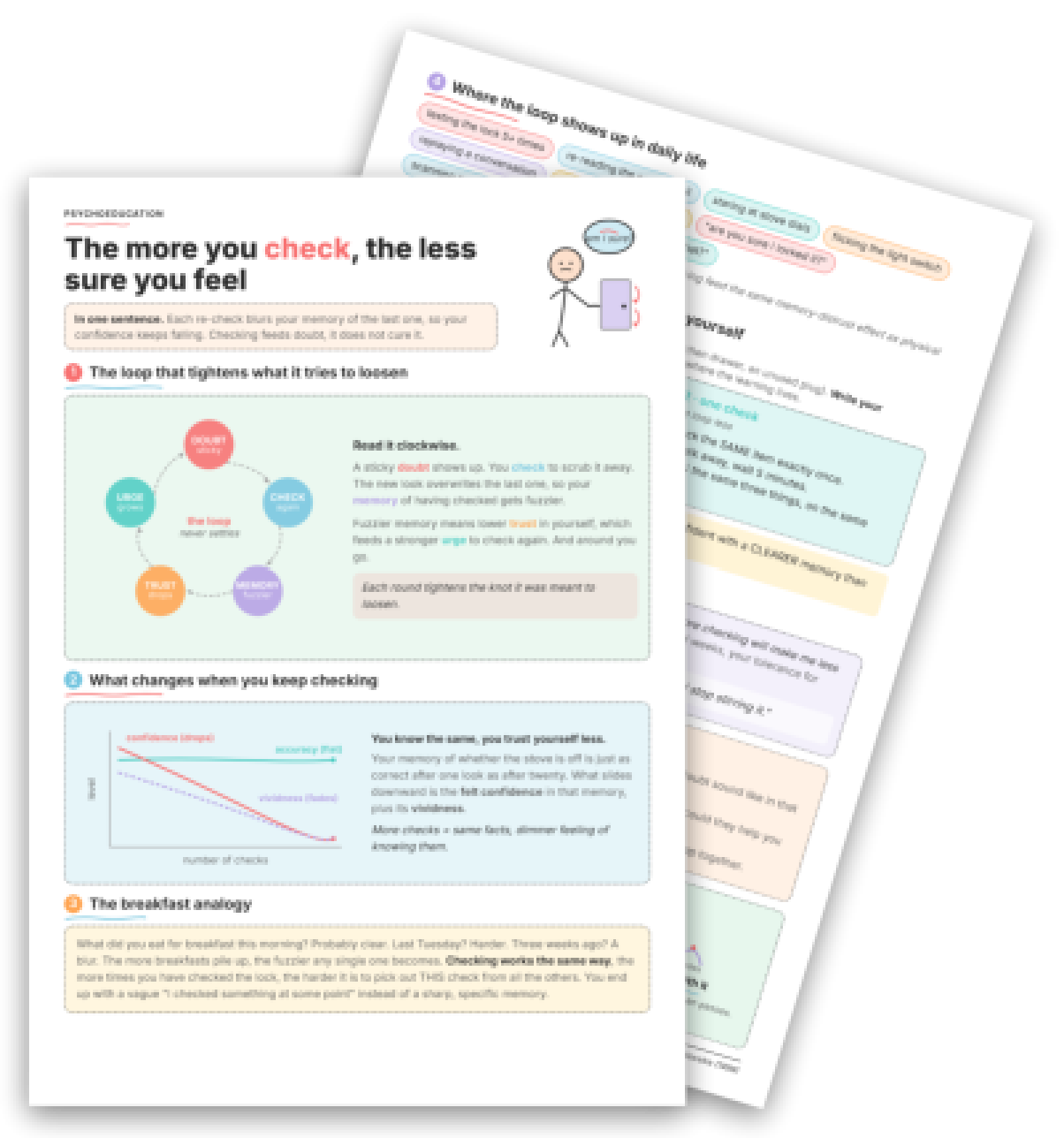
The fiche PDF opens with a clockwise loop diagram: doubt (sticky) → check again → memory fuzzier → trust drops → urge grows → back to doubt. The instruction "read it clockwise" orients the patient immediately. Shown spatially, this circularity communicates in seconds what a paragraph of verbal explanation struggles to land.
A second panel pairs the loop with a three-line chart tracking accuracy (flat), confidence (drops), and vividness (fades) across accumulated checks. The caption states plainly: "You know the same, you trust yourself less." Patients who have been justifying their checking with "but what if I really did forget?" can see, visually, that their factual memory is not the problem.
A third panel grounds the mechanism in an everyday analogy (breakfast memory clarity versus a meal from three weeks ago), and a fourth maps where the loop appears: "testing the lock 5+ times, re-reading the same email, staring at stove dials, mentally rewinding a drive." Critically, the fiche flags that mental checking counts, covering silent replays and reassurance-seeking alongside physical rituals. This shared vocabulary makes it easier to then introduce the OCD compulsion stopping criterion exercise without starting from scratch.
The centrepiece is a structured 2-day behavioural experiment. Day 1: the patient over-checks a low-stakes item for 30 minutes, waits five minutes, then rates confidence, vividness, and urge on a 0-10 scale. Day 2: one check only, same ratings. The fiche notes: "The numbers usually surprise." That surprise is the experiential data you debrief together. Three "To discuss in session" prompts close the sheet, including one inviting the patient to identify a reassurance-seeking partner and explore how that person could disrupt, rather than feed, the loop.
> Key point: The fiche is a visual support that facilitates the explanation in session, not a self-administered questionnaire. The loop diagram, the accuracy-versus-confidence chart, and the experiment protocol give you a shared reference point the patient can return to between appointments.
Use it with your patients
Share this tool in the mobile app and follow the work between sessions.
When and How to Introduce the Fiche
This worksheet fits naturally in the early psychoeducation phase of any presentation where compulsive checking is a maintaining behavior: OCD, health anxiety, GAD with repetitive doubt, or intolerance of uncertainty as a core maintaining factor. It also slots in when automatic avoidance and control behaviors feature alongside checking in the case formulation.
Introduce it once the functional analysis has confirmed checking as a maintaining behavior. A low-key framing: "I have something that shows, visually, why checking tends to make things worse. Have a look at this diagram while I walk you through it." Trace the clockwise loop together, then ask: "Where do you recognise yourself here?"
Before the session ends, assign the 2-day experiment as structured homework. At the next appointment, open with the ratings. The gap between Day 1 and Day 2 scores does the cognitive work; your role is to help the patient articulate what the numbers mean. From there, the intolerance of uncertainty exercise, a graded exposure hierarchy, and work on changing avoidance extend the intervention into full response prevention.
One practical limit: if the patient is in an acute phase with high obsessional distress, the 2-day experiment may be premature. Use the loop diagram and the accuracy-versus-confidence panel first, defer the behavioural component, and return to it once stabilisation and alliance allow. The fiche does not replace the therapeutic frame; it makes one critical piece of psychoeducation precise, portable, and memorable enough to survive the patient's next doubt-driven moment.
Your session continues in your patients' pocket
Use with a patientYour resources, available everywhere
The handouts, exercises, programs and audios above: you choose which ones to make available to your patients, in the mobile app dedicated to them.
And far more than a library
The app goes well beyond resources, to support your patients every day:
Related categories
Explore other clinical resources by category.

Anxiety
Clinical hub for anxiety disorders: CBT and ACT worksheets, psychoeducation sheets, and exercises for assessment and treatment across the anxiety spectrum.

Understand
Clinical hub for the therapeutic aim 'Understand': worksheets and tools to build patient insight across CBT, ACT, schema therapy and more.

Build awareness
Clinical worksheets and tools to build awareness in therapy: cognitive distortions, schemas, emotions, ACT and CBT resources for practitioners.

Exposure
Exposure therapy clinical resources for practitioners: worksheets, hierarchies, and psychoeducation tools for anxiety, PTSD, OCD, and avoidance-based presentations.

CBT
CBT worksheets, cognitive restructuring exercises & behavioral tools for clinicians. Evidence-based resources for every phase of cognitive behavioral therapy.

Trauma
Clinical hub on trauma and PTSD: assessment, differential diagnosis, treatment phases, and printable resources for practitioners. 155 chars.